Wednesday, April 18, 2018

Tuesday, April 17, 2018
Creative Critical Reflection #4 Draft
"How did you integrate technologies- software, hardware, and
online- in this project?"
Video/Sound Editing:
Adobe Premiere: This was the primary software I used when making
the film itself. Cutting clips, adjusting/adding audio, timeline, color
effects, and the title screen were all done in Adobe Premiere.
Microsoft Movie Maker: I used this software very little, but it
was still important for the sake of time and convenience. I use this program
personally quite often, so I was familiar with it to begin with. While Adobe
Premiere looks much cleaner and makes it easier to cut/edit audio, Microsoft
Movie Maker works just fine when adding captions. I would spend my time in
class editing with Adobe Premiere, and since it was faster to add credits on
Movie Maker, finish the render and add captions. The second draft, I used Adobe
Premiere to create the text of the title card, since its text options were less
limited, but all credits were still done in Movie Maker.
Adobe After Effects: I tried to use Adobe After Effects to create
an electricity effect on the frame where the agent offers our protagonist her
hand. It was meant to be a dramatic reveal that the agent was also super
powered. However, after watching a few tutorials, I realized the effect was too
ambitious as I had never used the program before. I instead aimed to create an
effect of fire on the agent’s hand, as there was a relatively simple tutorial
for it. However, finding free stock footage of fire was time consuming, as many
visual effects come in costly packages. Due to some troubles with Adobe After
Effects (multiple times it crashed or erased my work) as well as a lack of
time, I was not able to add the fire hand effect.
Organization:
Flash Drive: SanDisk 30 GB flash drive. I used this flash drive to
organize all of the location pictures, script drafts, footage, drafts, etc. in
one spot to keep my files organized and for easy access.
Google Blogger: The website has been the way I’ve documented the
process and research. It’s where my research is posted, drafts, plans, etc. for
my own benefit as a sort of central hub of completed steps. It is also to
document my work so that can be graded by Cambridge.
Research:
Online Research: My main source of research was through the online
search engine Google. I also used YouTube as a way to search for sound effects,
music, and even clips of films to analyze.
DVDs: I used multiple DVDs to research movie openings (i.e.
Guardians of the Galaxy and Iron Man).
Equipment:
D3200 Nikon Camera: Our group member Maya’s camera. We used the
camera on a tripod to get stable shots in filming, but there was a shot where I
tracked her while holding the camera (handheld shot creates tension).
RODE Videomic: A boom mic we used to capture the dialogue in our
intro.
Monday, April 16, 2018
Creative Critical Reflection #3 Draft
"How did your production skills develop throughout this project?"
Editing
When we
began, I felt like my strongest skill was editing. Since my main contribution
to the project was the editing of our film intro, I have learned and become
familiar with a professional grade editing software: Adobe Premiere. I feel
that I have improved greatly in editing by branching out into new programs,
researching its functions, and trying to perfect timing with visual and audio
elements.
Script
Writing:
In the
first stages of planning our project, I struggled with creating a detailed
script. I had a general idea of what I wanted to happen, but didn’t know how to
turn it into a script that was clear and easily communicated to others. By
communicating with my group, we worked through the scenes step by step, and by
doing so I was able to relay my ideas in a way my group understood and they
helped apply our knowledge and vocabulary of film techniques that we had
learned prior to started our project.
Understanding
of Elements and their effect on a scene:
When we
started filming on site, many factors came into play we had not originally
planned for or at least underestimated. For example, during our first shooting, we
filmed right as the sun was setting, so our first draft had inconsistent
natural lighting from shot to shot. We improved this in our second shooting,
making sure that we were on site at noon to ensure we would have plenty of
sunlight.
Another
element our group struggled with was pacing. Our concept of a super powered
protagonist being approached by a secret agency was failing to be portrayed
clearly because of its pacing, order, and timing. We tried to have as little
dialogue as possible for the actor’s sake, but it meant a lack of exposition.
After our first draft was critiqued by the class, our teacher helped us
rearrange the timeline of our film and adding shots to create exposition and
context without dialogue.
Before
this project, I had not worked with sound effects. Using royalty free
incidental music as well as sound effects meant my options were limited. I
could never find a sound that fit a scene exactly the way I wanted. For
example, finding a sound effect for the close up of the robber punching (fake,
of course) was difficult because all the free punch or fight sound effects were
either too unrealistic or sounded too plain. I ended up looking at different
sound effects entirely, using an audio bit from a compilation of people
falling. Working around these limitations as well as timing
them up with their events helped me improve greatly in finding and editing
audio.
Overcoming
setbacks:
There
were many non-technique factors that hindered our filming. Our film site was a
part of St. Armands because of its large number of people walking past shops
and restaurants. We thought a crowded place would be what was best for our film
introduction because it made the background feel more natural, created tension
that the protagonist had forgotten to conceal her powers in front of other, and
made the scenes where the agent character is following our protagonist more
dramatic because they contrast with the crowd. However, to get these effects,
our filming had to be in the middle of crowded foot traffic. We had to move our
camera multiple times after a shop keeper was worried that people, while trying
to avoid the camera, were being “blocked” from her store. At other times, we
would finish one shot, and when we would replay it to see if we liked it- it
would be ruined by a passerby looking directly into the camera, even pointing
at it, as they walked by.
Another
setback came from a crowded restaurant. When we were scouting locations to film
our intro, I had hoped to get an above view. So we asked one of the restaurants
who had a second story if we could take a few pictures from their upper deck.
While they were more than happy to help us, on the night of our first filming
their upper deck was so crowded they could not let us up there. We overcame
this by having our tallest actor stand on a bench, holding the tripod fully
extended above his head to get at least an above angle. When it came to
refilming, we had chosen a less busy time of day and were able to get the above
shot we originally wanted.
Through
patience, retakes, and proper scheduling we were able to improve all of our
production quality by learning from our mistakes.
Saturday, April 14, 2018
Creative Critical Reflection: #2
"How does your product engage with daudiences and how would it be distributed as a real media text?"
Marvel's Black Panther had an unprecedented grass roots marketing campaign, with countless communities of African Americans coming together to discuss the movie. A Boys and Girls Club in Harlem, NY managed to raise enough money to buy tickets to see the film for 400 children. There were also multiple comedic promotional videos on social media to create hype for the movie. It showed the actors in a more down to earth, relaxed manner that made them seem charismatic and likable. By doing so, viewers were able to connect with the actors and their characters more easily, creating excitement.
The elements to take away from these advertisements are to target advertising heavily at the minority groups being represented, while also encouraging them to create excitement and momentum within their own communities. Our group can also learn from their mistakes, and avoid topics that would be viewed as a harmful stereotype of the minority group. For example, we would not show our protagonist (a female hero) with humorously poor driving skills in a car commercial.
A studio that has produced successful action films is Millennium Films. I believe this studio would be best for our film because it has released films about action heroes that are not affiliated with Marvel or DC (the major comic book hero companies). They have produced (and are producing a new movie) of the comic book protagonist Hellboy, who was published in Dark Horse Comics. Because they have dealt with similar subjects and are one of the longest running independent studios, it would work well with our film and help it to gain notoriety while also having the resources to create a quality film as well as launch an extensive advertising campaign.
Millennium Studios will also have connections with theaters, and our film will take the traditional route and run in theaters for about two months.
After its run in theaters, our film will be distributed in DVD and Blu Ray format, available for rent at kiosks like Redbox or for sale in a variety of big-box stores (i.e. Walmart, Target, Best Buy).
To follow the rising trend of digitization and streaming movies digitally, our film would be available to rent or buy on digital stores such as Google Play or or Apple's App Store. YouTube has a new, similar function where users can pay to rent or own movies through the YouTube website. Our film would also be available on popular streaming services such as Amazon, Hulu, and Netflix.
Thursday, March 15, 2018
Creative Critical Reflection: #1
While our film may stand out in certain ways, there are still many conventions of action, super hero movies that our film project conforms to.
When studying techniques of the genre, I noticed a common theme (in movies like Iron Man) that the title card was shown after a short introduction. It was bold, impactful, and normally accompanied by either a musical sting or abrupt stop in tension building music. This grabs the audience's attention, leaves an impression, and creates an effect of power and intensity. We wanted to replicate this with our own project, so we placed the title card at the end on the introduction with suspenseful music coming to an echoing stop. Upon showing our test audience, some expressed the concern that it made the intro feel more like a completed short film. In order to emphasize a cliffhanger aspect of an intro, we added a line of dialogue to imply that there was in fact a (hypothetical) full length movie after it. When the Agent character says, "I have a job for you." the screen cuts to black. During the black screen and absence of music, the protagonist can be heard saying, "I'm listening." After this, the title card fades in. We believe this helps express that it is not the end of the story.
Another convention of this type of film is that the introductions begin with a calm, slow pace. No one is in a rush, there is no danger. Slowly tension builds, and then a climax to the conflict. In Captain America the First Avenger, a group of men are in multiple long takes as they exchange causal dialogue, until the music changes and the camera pans to a massive ship that had been preserved in ice. In Iron Man, there are long shots of military vehicles, casual conversation, and then the sudden sound of gunfire and explosives. We wanted this effect of building tension in our film, beginning the scene with establishing shots and long takes of cars driving by and people walking by. Then the characters are shown walking lazily, window shopping. Slowly the tension builds to the Robber taking the purse, and the tension repeatedly rises and falls as the protagonist defeats the robber twice and is then cornered by the Agent.
When the Agent corners the protagonist, we follow a convention of all adventurer and hero stories. The Agent introduces the "call to action" portion of the story, the "job" they offer.
Unlike many other super hero franchises, however, we skip past the "origin story" portion of a hero's journey. When the audience meets the protagonist, she has already gotten the hang of her powers and has had them for a while. When she recognizes the Agent is watching her, she realizes she is being followed. This implies that she has had to deal with this before, running and hiding her super powers. When she fakes being injured, she remembers she has to act like she does not have super strength. This sort of head start is not normal to many hero movies.
Our hero also lacks a special code name or costume. Unlike "Bat Man" or "The Wasp", she has no famous second identity. She also lacks an elaborate suit or mask, as is characteristic of most crime fighting heroes.
A more obvious deviation from convention is the fact that our super hero lead is a woman. Nearly all super hero movies are led by male heroes, with rare exceptions such as "Cat Woman" or the recent "Wonder Woman".
Our film represents multiple woman in its cast, of different body types and personalities. So our film's primary social group is woman. By doing so the film is tackling the issue of a lack of relatable role models for younger girls. Our film would follow the lead of the recent "Wonder Woman" film, providing positive examples of strong woman and promoting diversity in film.
Wednesday, March 14, 2018
Revision 3: Title Card
One of the revisions we decided to make was to rename the excerpt. We mean the original title of Fox Hunt to represent how the movie is about finding the protagonist and characters with cunning like a fox. However, this was not very clear to our test audience.
We thought of making the logo/mascot of the agency the Agent character worked at a fox, to make a more clear connection. However, it was difficult to fit into the script we already had, so instead we renamed it to "New Recruit", which still fits out excerpt.
In editing, I also made the title card look more sleek and gave the text a gradient effect to look more professional.


We thought of making the logo/mascot of the agency the Agent character worked at a fox, to make a more clear connection. However, it was difficult to fit into the script we already had, so instead we renamed it to "New Recruit", which still fits out excerpt.
In editing, I also made the title card look more sleek and gave the text a gradient effect to look more professional.


Thor Ragnarok Distribution Model Research
Thor Ragnarok has taken advantage of traditional distribution methods as well as more modern. experimental ones.
For example, Thor Ragnarok ran in theaters and has DVDs and Blu Ray disks available for purchase. These methods are common and have been used for years, and are proven to be profitable.
However, as a way to alter this tried and true method, Marvel had a special promotion DVD set with the Target chain of stores. The set held a DVD, a Blu Ray Disk, a code to redeem a digital copy of the movie (for mobile devices or computers), and extra features like a behind-the-scenes book.


For example, Thor Ragnarok ran in theaters and has DVDs and Blu Ray disks available for purchase. These methods are common and have been used for years, and are proven to be profitable.
However, as a way to alter this tried and true method, Marvel had a special promotion DVD set with the Target chain of stores. The set held a DVD, a Blu Ray Disk, a code to redeem a digital copy of the movie (for mobile devices or computers), and extra features like a behind-the-scenes book.
Thor Ragnarok is available for streaming on Amazon, and while it is not currently on Netflix it is planned to be released there sometime this summer.
A more experimental streaming service Ragnarok is using, however, is YouTube. You can purchase the movie for rent or to own on the site, a fairly new way to stream movies. Larger film studios have only started to use this function on the massively popular video streaming service.


This is a screenshot I took myself. Movies are now even easier to access for streaming on YouTube.
Tuesday, March 13, 2018
Revision 2: Fixing the Lighting Inconsistency of our Intro
One of the elements we wanted to fix in our original draft was the fact the sun had set in the middle of filming. making the lighting inconsistent. It was too out of place and made no sense, as shots meant to be one after another get progressively darker. In these screenshots of the original draft, you can see the how quickly and abruptly it becomes dark in about 30 seconds.


We realized to fix this lighting inconsistency we would have to refilm portions of our intro, but after recasting actors it became impossible to reshoot only segments of our project. So we had to refilm the sequence altogether. In our revised 3rd quarter draft, we made sure to start filming much earlier in the day. This gave us around 6 hours of sunlight instead of 1. The following screenshots show that throughout the excerpt the daylight creates a much more consistent lighting and does not cause distraction or break immersion.


Monday, March 12, 2018
Spider Man Homecoming Advertising Campaign
Sony claims they have "evolved" their advertising campaigns to surpass a simple 30 second commercial slot.
Spider Man Homecoming has not only has TV and online commercials, but partnerships and co-beneficial product placements.
The movie had an exclusive, custom ad for the NBA Finals.
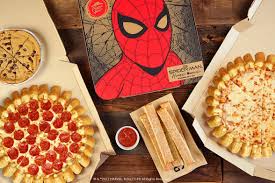
The movie had a duel ad with the computer company Dell, the car company Audi, and even Pizza hut.
Pizza Hut boasted special edition sporting the comic book hero's likeness, along with a promotional food item called "Cheesey Bites".

Sony had both a partnership with Audi and a product placement within the film itself. Audi produced a comical short, with the protagonist Peter Parker taking his driver's license test. This provided hype for the movie while also giving fans extra content. There were also publicity stunts, like a costumed Spider Man posing with crowded fans on the hood of a detailed Audi car.


Spider Man Homecoming has not only has TV and online commercials, but partnerships and co-beneficial product placements.
The movie had an exclusive, custom ad for the NBA Finals.
The movie had a duel ad with the computer company Dell, the car company Audi, and even Pizza hut.
Pizza Hut boasted special edition sporting the comic book hero's likeness, along with a promotional food item called "Cheesey Bites".
A scene from the film where Spider Man commandeers another student's car.
Audi's promotional short.
Spider Man posing with excited fans on top of a custom Audi for a publicity stunt.
Subscribe to:
Posts (Atom)
